Estimate fish weight from length and girth
Select the fish species, enter its length and maximum girth, and get an estimated weight in kilograms and pounds. The formula is weight (lb) = length (in) × girth (in)² ÷ species factor. Each species option supplies the factor; centimeter inputs are converted automatically.
Behind the estimate.
Two measurements. One species factor.
Here’s what goes into your fish’s estimated weight.
Small equation. Useful insight.
Length and girth give us a way to estimate body size. The selected species factor turns those measurements into an estimated weight.
- W
- Weight · lb
- L
- Length · in
- G
- Girth · in
- F
- Species factor
Using centimeters? We convert to inches first, then convert the result to kilograms.
Different fish. Different factors.
Fish have different body shapes: deep-bodied, cylindrical, or torpedo-shaped. These simple silhouettes show the shape categories behind the three species examples.
Illustrations are schematic. Factors are calculation presets, not a 3D body model.
Data Sources
Explore authoritative resources for fisheries data, research, and angling records:
Measurement Standards
IGFA-approved measurement protocols
Accuracy when measurements are taken properly
- ±2% measurement error tolerance
- 5-point verification system
- Digital calibration guidelines
Girth has twice the influence.
Because girth is squared, measuring it 5% larger raises the estimate by 10.25%, with length and species unchanged.
Worked example · largemouth bass · 20 in long · factor 1200
Fish weight calculation examples
These are illustrative calculations, not measured catches. Each example uses the same formula as the calculator, with equivalent metric and imperial inputs.
Largemouth Bass
- Length
- 20 in / 50.8 cm
- Girth
- 12 in / 30.48 cm
20 × 12² ÷ 1200 = 2.40 lb
1.09 kg2.40 lb
Rainbow Trout
- Length
- 16 in / 40.64 cm
- Girth
- 8 in / 20.32 cm
16 × 8² ÷ 800 = 1.28 lb
0.58 kg1.28 lb
Common Carp
- Length
- 24 in / 60.96 cm
- Girth
- 18 in / 45.72 cm
24 × 18² ÷ 1350 = 5.76 lb
2.61 kg5.76 lb
How to measure length and girth
- Prepare first. Have a flexible tape and a wet, supportive surface ready. Keep handling brief and support the fish’s body.
- Measure length. Measure from the snout tip to the tail fork, in a straight line. Do not mix this with total length or a curved measurement along the body.
- Measure girth. Wrap the tape around the thickest part of the body. Keep it snug without compressing the fish.
- Enter both values. Select centimeters or inches and your fish species. Switching units converts the measurements already entered.
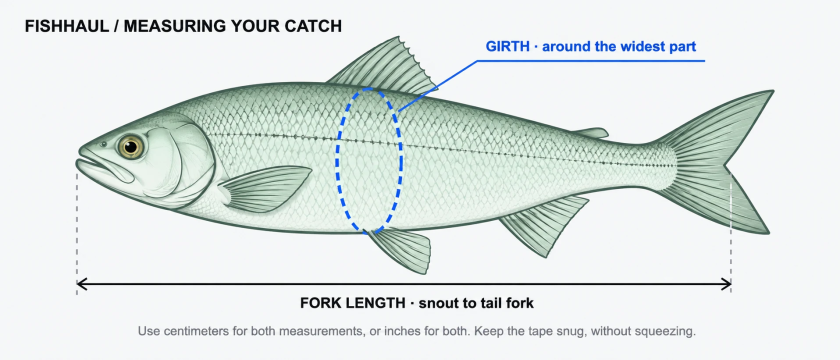
Girth is squared in the formula, so small measuring differences matter: a 5% larger girth produces about a 10.25% larger estimate at the same length.
Calculation methodology
FishHaul uses 33 species options with a consistent conversion between units. Equivalent measurements in inches and centimeters produce equivalent estimated weights.
Formula: estimated pounds = length (in) × girth (in)² ÷ species factor. For centimeter inputs, divide both measurements by 2.54 first. Multiply the pounds result by 0.45359237 to obtain kilograms.
The calculator does not adjust for season, spawning condition, region or individual body shape.
Use the result as a rough catch estimate. Record a scale reading when you need measured weight, and label calculated weights as estimates in your own notes.
Supported species and weight factors
Use these factors with length and girth in inches. Each option has its own calculation factor.
Download all 33 species factors (CSV)
33 species options
| Species option | Factor F | Select species |
|---|---|---|
| Largemouth Bass | 1200 | |
| Rainbow Trout | 800 | |
| Atlantic Salmon | 740 | |
| Channel Catfish | 1100 | |
| Walleye | 2700 | |
| Northern Pike | 3500 | |
| Muskellunge | 4200 | |
| Black Crappie | 2000 | |
| Bluegill | 2500 | |
| Red Snapper | 2200 | |
| Yellowfin Tuna | 850 | |
| Atlantic Cod | 1150 | |
| Pacific Halibut | 950 | |
| Common Carp | 1350 | |
| Nile Tilapia | 1800 | |
| Smallmouth Bass | 3100 | |
| Lake Sturgeon | 1800 | |
| Zander | 2800 | |
| Pikeperch | 2600 | |
| Tench | 3200 | |
| Giant Snakehead | 1900 | |
| Golden Mahseer | 1650 | |
| Catla Carp | 1450 | |
| Blue Marlin | 650 | |
| Sailfish | 750 | |
| Wahoo | 900 | |
| Mahi-Mahi | 950 | |
| Goliath Grouper | 1050 | |
| Atlantic Tarpon | 1250 | |
| Bonefish | 2800 | |
| Great Barracuda | 1350 | |
| Swordfish | 580 | |
| Haddock | 1275 |
Zander and Pikeperch are available as separate options with different factors; the names can refer to the same fish. Treat these as calculation presets, not a taxonomic distinction. Common Bream is unavailable because a supported factor is not available.
Fish weight calculator questions
How do you estimate fish weight from length and girth?+
Multiply length in inches by girth in inches squared, then divide by the selected species factor to estimate pounds. For centimeter measurements, divide each measurement by 2.54 first. Multiply pounds by 0.45359237 to get kilograms.
Can I estimate fish weight using length alone?+
This calculator needs both length and girth. Fish of the same length can have different body sizes, so a length-only estimate needs a separate species-specific model.
How accurate is the fish weight calculator?+
It is an estimate, not a measured weight. Body shape, condition and measurement technique affect the result. Use a suitable scale when an accurate weight matters.
Does switching between metric and imperial change the estimate?+
No. FishHaul converts the measurements and uses the same species factor in both modes. The estimated weight stays equivalent, apart from display rounding.
Is the calculator free, and are measurements saved?+
The web calculator is free and requires no account. Calculations run in your browser. Measurements are not sent to a server or saved to a FishHaul catch log.
What if my fish species is not listed?+
Use a suitable scale or a published model for that species. Choosing an unrelated species can give a misleading estimate. Common Bream is omitted because a supported formula is not available.
Should I measure total length or fork length?+
Use fork length for this calculator, from the snout tip to the fork in the tail. Total length extends to the farthest tail tip. The measurements are different, so do not substitute one for the other.
How do I measure a fish’s girth?+
Wrap a flexible tape around the widest part of the body, perpendicular to its length. Keep the tape snug without squeezing the fish, and record the full circumference rather than its width or depth.
What does the species factor mean?+
The species factor is the divisor F in estimated weight in pounds = length in inches × girth in inches squared ÷ F. A larger factor produces a lower estimate for the same measurements. Select a supported species rather than choosing a factor by body shape alone.
How much do measurement differences affect the estimate?+
At the same species factor, a 5% increase in length increases estimated weight by 5%. A 5% increase in girth increases it by 10.25%, because girth is squared. Recheck the tape position if repeated measurements differ.
Keep learning about your catch
Explore FishHaul’s planned fish identification tools, the catch log, and weight estimation in the app. The web calculator is available now; the app features are in development.
Page updated